
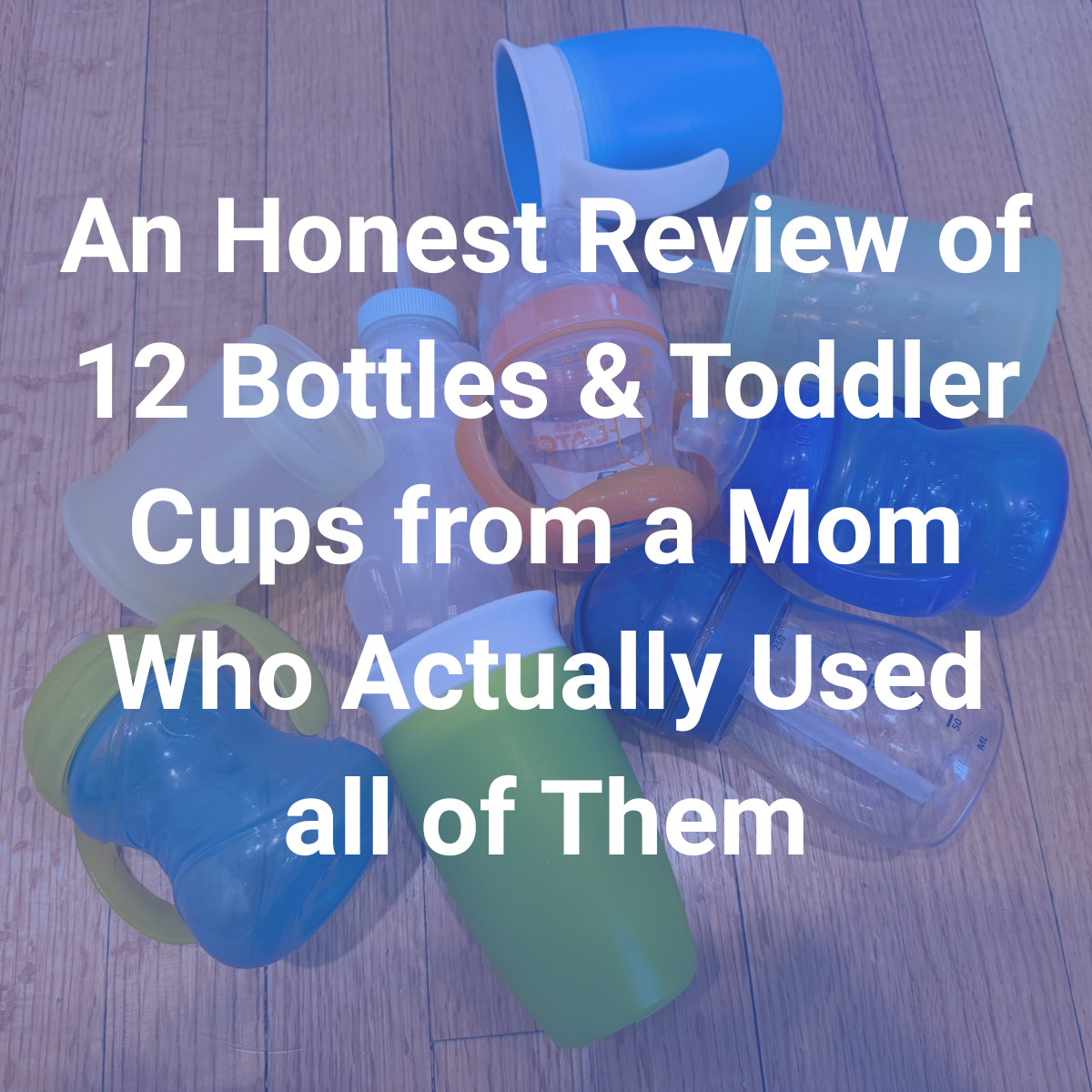
I put twelve different bottles and toddler cups to the test with my three sons. Yes, twelve. Before you think I’m crazy, my youngest son never took a bottle, leaving us desperate for anything he’d accept.
This isn’t your typical internet bottle roundup. You won’t find me reciting manufacturer features (though I’ll link their videos if you need that info) or gushing, “my baby loved it!’ Often, mine didn’t.
Instead, this post offers an honest assessment of the parent perspective, highlighting user-friendliness and my personal journey with each one. You’ll find classics alongside some more eclectic options.
Full disclosure: there are no affiliate links here—though believe me, I wish there were. I poured a ton of money into these bottles.
The Bottles
A bottle isn’t just a beverage container. For a breastfeeding mom, it’s a moment of freedom. For a working parent like me, washing and labeling enough bottles for the workday can suck away hours of your life. Here are the ones that truly deliver, and the ones that don’t.
Dr. Brown’s Anti-Colic Bottle
The OG bottle of modern parenting, we used these bottles with our two older sons. We bought the Dr. Brown’s Anti-Colic Bottle because it’s supposed to be the best for preventing or reducing issues with gas and fussiness. Since both my husband and I had colic as babies, we didn’t want to take any chances. Thankfully, none of our kids developed colic, but these bottles still proved to be a good fit.
Dr. Brown’s bottles are available in narrow or wide sizes and come in plastic and glass. We used the narrow plastic bottles, which are very portable. They don’t take up much space in a diaper bag and fit easily into bottle warmers.
Our lactation consultant recommended these when our youngest struggled with bottle-feeding due to a tongue tie, which made controlling milk flow difficult. Turns out, Dr. Brown’s premie nipple offers the slowest flow of any major bottle on the market, making it an excellent choice for babies with feeding issues or those who are premature.
MAJOR CAVEAT: Don’t choose Dr. Brown’s bottles if you don’t have a dishwasher! They have several small parts, some of which are a nightmare to clean by hand. If you do have a dishwasher, no problem. Get a dishwasher basket, pop the pieces in, and you’re all set.
Also of note, the nipple on Dr. Brown’s bottles is longer than those on other bottles. The length proved tricky for our tongue-tied baby. Dr. Brown’s might not be your best bet if your baby has severe tongue-tie problems or other similar issues.
This bottle IS for you if:
- Your baby has colic or gas
- You need a wide range of nipple flows that will grow with your baby
- You want plenty of options for size or materials
This bottle is NOT for you if:
- You don’t have a dishwasher
- Your baby has a tongue tie or other physical issue that makes a long nipple difficult to use
Phillips Avent Natural Baby Bottle
We then turned to the Philips Avent Natural, which claimed to allow the baby to control milk flow as they would during breastfeeding. Most other bottles allow milk to flow freely, regardless of whether the baby is sucking.
The Philips Avent Natural has just a few simple pieces, making it easy to assemble and disassemble, and it comes in plastic and glass. It’s easy to use and I have no complaints.
This bottle IS for you if:
- You want your baby to have complete control of milk flow, like they would when breastfeeding
This bottle is NOT for you if:
- Honestly, I’ve got nothing here. It’s a pretty solid option.
Comotomo Bottle
The Comotomo Bottle advertises itself as being more breast-like than other bottles, featuring soft silicone designed to mimic a mother’s breast. While a nice feature for older babies, it’s not a huge selling point for newborns who can’t hold a bottle yet.
The clear silicone nipple is also softer and more supple than many other bottles we tried. While it’s not identical to a human breast, it’s certainly closer.
One major downside is that the silicone is nearly impossible to label. If you need to label your bottles for daycare, Sharpie doesn’t stay on, and adhesive labels won’t stick.
It’s a very wide bottle, so standard accessories (like the handles we tried for our little one who preferred feeding himself but couldn’t hold the bottle yet) usually won’t fit. You’ll need specialized accessories for the Comotomo.
Overall, if you’re looking for something that feels more breast-like but is still relatively “normal,” this is a solid choice.
This bottle IS for you if:
- You want a standard bottle with a more breast-like shape and feel
This bottle is NOT for you if:
- You want a bottle that’s easy to label
Emulait Bottle
The Emulait Bottle stood apart from everything else we tried. And despite the high price, I wish we had discovered it sooner. It might have made a real difference in our son’s bottle-feeding journey.
The Emulait bottle is designed to look and feel like a mother’s breast in a way no other bottle I’ve used does. When you buy the bottle, you choose a skin tone color and nipple shape that most closely match your own. You can even scan your nipples with their app to find the best match (I skipped that step). There’s no one-size-fits-all approach here.
Emulait bottles come in two shapes:
- The Anatomy bottle is supposed to mimic the positioning of a breast when the baby is breastfeeding. We didn’t try it because it’s an awkward, non-portable shape. It would be fine for feeding at home, but it won’t fit in a traditional bottle warmer and takes up a lot of space in diaper bags.
- We opted for the Classic bottle, which is still large and breast-shaped. But it does fit in a bottle warmer, and it doesn’t have as large a footprint in bottle bags.
The nipple’s texture is unique. Nothing will feel exactly like a human breast, but Emulait came closest. It features fibers designed to mimic milk ducts and a flow plate engineered to replicate areola bumps during breastfeeding. The Emulait bottle comes in plastic or glass with a flesh-colored silicone base to help keep it from slipping and tipping.
What made the high price tag feel more reasonable was that it included all three flow plates (slow, medium, and fast). With other brands, we bought the bottle, then had to purchase multiple extra nipples to find the right flow.
Emulait has updated their bottles with an infant-controlled flow, allowing them to adapt to the baby. As a result, there’s no need to buy additional nipples as your baby grows, unlike with many other bottles.
Some users complain that the nipple collapses during feeding. The company released an explainer video to address this issue. We never faced this problem though, so I can’t speak to whether their solution is effective.
This bottle IS for you if:
- You have a breastfed baby who’s all about the boob
- You want to simulate a natural breastfeeding experience
This bottle is NOT for you if:
- You need a narrower bottle that’s easy to pack
- You have a tight budget
NUK Simply Natural Bottle
We tried the Nuk Simply Natural bottle for its unique nipple shape. It’s flat on one side and curved on the other, mimicking a real nipple during breastfeeding.
The Nuk Simply Natural bottles are compact, lightweight, and easy to use. Like many other bottles, the Nuk bottle has only a few pieces, making it very simple to assemble. They also have a wide neck without taking up a ton of space.
The crystal-clear plastic makes measurement markings easy to see—a feature we found invaluable when meticulously tracking every precious drop our baby consumed.
This bottle IS for you if:
- You want something with a wider neck that’s still easily portable
- You need to be able to see clearly how much your baby is drinking
This bottle is NOT for you if:
- Again, no complaints on this one. Another solid option.
MAM Easy Start Bottle
We tried the MAM Easy Start bottle because of its distinct nipple shape, which is very flat. It’s supposed to mimic the natural compression that occurs during breastfeeding.
Our feeding therapist discovered that the Mam nipples have a much faster flow than other brands at the same level. They’re ideal for a voracious eater, but not the best choice if your baby needs something gentler.
This bottle has five parts, compared to the usual three. The bottom screws off there’s a silicone vent inside. The removable bottom is meant to help the bottle dry faster. I didn’t get out a stopwatch, but I know for sure we’re not talking about lightning speed here. For us, the additional pieces were a hassle, not a convenience.
The markings at the very bottom of the bottle were impossible to see when you reached the last couple of ounces. It was beyond frustrating. Our youngest never drank more than two ounces, making it almost futile to try to gauge how much he had consumed due to the clouding on the plastic bottle and the large, colored plastic base.
We used the MAM bottle more frequently because our son drank more milk from it (although that was due to the faster flow, so it was cheating). But it was my least favorite in terms of user experience.
This bottle IS for you if:
- Your baby likes to suck down a bottle quickly
- You want something with cute designs
- You need a bottle that dries a little faster
This bottle is NOT for you if:
- Your baby needs a slower flow
- You don’t want to deal with extra pieces
- You need to be able to track how much your baby is drinking
The Cups
I have a lot more user data to run on when it comes to cups. Some were temporary transition options, while others lasted us well into toddlerhood.
Nuby Sippy Cup
We used the Nubby sippy cup as a transition from bottles to the Munchkin 360 cup for our older two boys, mainly because their daycare used them. These cups are bright and colorful, and they only have three dishwasher-safe pieces, making them easy to clean. The soft silicone spout is bottle-reminiscent, but it’s wide enough to feel significantly different from a nipple. It takes a little finagling to get the spout into the top, but it’s not a huge deal.
These cups didn’t have much longevity for us, mainly because we were mirroring what the boys got at daycare for consistency. Unless you’re concerned about your baby’s bottle-to-cup transition — or, like us, your daycare requires a spouted sippy cup —you’ll get more lifespan from a straw cup or the Munchkin 360.
This cup IS for you if:
- You want something bright and colorful
- You want a gradual transition from bottles to other cups
This cup is NOT for you if:
- You want something you can use for a while
Munchkin Miracle 360 Cup
The Munchkin Miracle 360 training cup is unique in the world of toddler cups due to its spoutless design, which helps toddlers learn to sip like big kids with less mess. They come in shorter and taller sizes, with or without handles, and in a variety of fun colors. They even come in stainless steel if you’re looking to ditch plastic.
The cup has three components that are easy to pop apart and reassemble, and they’re all dishwasher safe. Dentists recommend them because the design doesn’t cause the oral development issues that bottles and spouted cups can.
A word to the wise: these cups are leak-proof, not spill-proof. So when your toddler inevitably hurls their cup from their highchair, you will get milk splatters everywhere. Our kitchen wall looked like a Jackson Pollock.
We’ve used our Munchkin cups for years with all three kids and have been very happy with them. I’d recommend them for anyone looking to move to a big kid cup with less mess. Not ‘no mess,’ but significantly less than a toddler dumping milk down their shirt.
This cup IS for you if:
- You’re concerned about dental development
- You want a cup you can use for the long haul
- You want lots of options for colors, materials, and personalization
This cup is NOT for you if:
- You want a spill-proof cup
Munchkin Latch Trainer Cup
We tried this sippy cup because we started our youngest on a sippy earlier than most babies typically do to see if he preferred it to a bottle. The Munchkin Latch Trainer Cup (now the Gentle Transition Sippy Trainer Cup) is the only one we found recommended for babies four months and older.
The Latch Trainer is a tiny step from a bottle to a sippy cup. The spout is made of a very soft silicone, similar to a bottle nipple, and less rigid than the spouts on many other sippy cups. That texture makes this a very gentle transitional cup. If you have a baby who’s very attached to their bottle, this might be a good choice.
Another nice perk was that it came with a lid, which was helpful since our daycare required infant bottles and cups to be covered.
It has a removable venting piece inside for easy cleaning, which you’ll need to pinch open for proper venting. Not a major concern, but worth noting.
The handles attach at the bottom and are easy to remove, but the process isn’t intuitive. You’ll likely need to read the instructions to figure it out.
This cup IS for you if:
- You want to introduce a sippy cup to a younger baby
- You want a gentle transition from bottle to cup
- Your baby is obsessed with their bottle and doesn’t want to give it up
This cup is NOT for you if:
- You want a cup that you can use for a long time
Honey Bear Cup
The Honey Bear Cup saved us. Designed by specialists, this adorable tool teaches children struggling with oral motor skills how to drink from a straw.
It’s named the Honey Bear because it looks like the little bear-shaped honey bottles found in grocery stores. It’s made of very soft plastic that’s easy to squeeze—but be careful, it doesn’t take much!—and has a narrow silicone straw.
You teach a child to drink from the straw by gently squeezing the bear, allowing liquid to flow into their mouth. They quickly learn that straws deliver a yummy drink, then figure out how to suck and eventually manipulate the cup independently.
We also used knock-off Honey Bear cups from Amazon because they came in a taller size (9 oz vs. 5 oz). The original Honey Bear cup now also offers a 7-oz option. The straws are very long but are trimmable.
The Honey Bear is a fabulous cup. We used it consistently for over a year, and it was incredibly helpful. I’m only now about to retire it because my now two-year-old has figured out how to take off the top.
If your child is having trouble forming their mouth to sip a straw, know that this straw is very narrow, which might be trickier than a wider straw. Our son was nine months old when we introduced this cup, though, and it didn’t take him long to get the hang of it.
The website for the original Honey Bear cup says it’s not dishwasher safe. We 100% washed ours in the dishwasher. Oops. It always came out fine, though. The cup is, let’s call it, leak-resistant, and not spill-proof.
This cup IS for you if:
- Your child has oral motor development challenges
- Your kid can’t seem to figure out a straw
- You have a bottle-averse baby who needs to realize that other things besides mom can deliver the good stuff (just me?)
This cup is NOT for you if:
- You want something spill-proof or leak-proof
- You have a baby Hercules who will never catch on to squeezing something gently
Olababy Training Cup
The Olababy Training Cup features a slightly wider silicone straw and comes in cute pastel colors. The measurement markings, which the Honey Bear cup doesn’t have, are a handy feature. If you’re still tracking ounces, the Olababy Cup is an ideal choice.
They are available in two sizes: a small 5-ounce size and a larger 9-ounce size. The straw is thicker and wider on the larger cup, allowing it to accommodate thicker liquids, like smoothies.
The Olababy cups are more expensive than your average sippy cup, but they’re designed to grow with your child. You can remove the straw, and your child can sip through the hole in the lid as a trainer for an open cup. Then, it can be used as an open cup when your child gets older.
They have a nice flat base to keep the cup from slipping. There’s also a stopper at the end of the straw to prevent your kiddo from pulling it out of the hole (another win over the Honey Bear).
Keep in mind that the Olababy cups are neither spill-proof nor leak-proof, so they don’t travel well. For everyday use, they’re fantastic.
This cup IS for you if:
- You like options for different colors
- You want something with multiple functions
- You want a cup that you can use for years
- You want to keep track of how much your kiddo is drinking
This cup is NOT for you if:
- You need something spill-proof and leak-proof
Oxo Transitions Straw Cup
Did someone mention a straw cup for travel? Allow me to introduce the Oxo Transitions Straw Cup. It has a movable lid to cover the straw and keep it clean while you’re on the go. It’s also leak-proof and spill-proof, which is super helpful when you’re traveling or don’t want your child throwing the cup in the car and making a mess. We successfully brought this cup on an overseas flight without a single stray drop.
Because it’s leak-proof, the straw requires a bit more sucking pressure. Our youngest couldn’t manage it when he was new to straw cups, but by around 10 months old, he had no issues.
The Oxo Straw Cup is dishwasher-safe and features clear, easy-to-read measurement markings. It’s a fabulous on-the-go straw cup.
This cup IS for you if:
- You want a travel-friendly straw cup
- You want a cup that’s fully spill-proof and leak-proof
- You want to be able to cover the straw to keep it clean
This cup is NOT for you if:
- You have a younger baby
- Your baby is just starting with straws
Choose the bottle that will work for your baby AND you
If I could impart one piece of wisdom from our journey with all these bottles and cups, it’s this: Beyond physical limitations like flow rate or nipple size, no single bottle holds the key to feeding success. If your baby is motivated to drink from a bottle or cup, they will. If they’re not, they won’t. The vessel doesn’t matter to them.
What does matter is whether the bottle or cup makes your life easier or harder. So don’t obsess over the latest innovations in research or design. Find what works for you, the parent, and run with it. Your baby will figure out the rest.
Does your company serve parents and families? I’m a freelance parenting writer and mom of three, committed to using words to make parenting a bit easier. I’d love to work with you! Contact me to chat.
Never miss a post. Subscribe to get the latest straight to your inbox.
Leave a Reply